Showing posts with label Snapdragon 820. Show all posts

Saturday, 18 June 2016

XIAOMI MI 5: A FLAGSHIP CONTENDER AT MID-RANGE PRICE - RM1549


With possible teasers of the main flagship from Xiaomi signaling its entrance onto our shores, it’s time to take a look at Xiaomi’s next flagship, the Xiaomi Mi 5.

Launched during the Mobile World Congress (Barcelona) earlier this year. It took them some time to finally possibly bringing the device here.

Among all of the launched smartphones this year, the Mi 5 was one of the earliest to sport the latest Snapdragon 820 from Qualcomm. A quad-core high performance processor found also in the LG G5 and S7/Edge. Consumers have the option of having the 3GB RAM or 4GB RAM. Keep in mind that the 3GB models are only paired with storage of 32 and 64 GB.

The 4GB RAM is considered as the Pro edition, comes along with 128GB of internal storage.
The internal storage is now using UFC 2.0 that promises higher write and read speeds (almost double that of the standard eMMC 5.0)

The Mi 5 is has a 5.15-inch Full HD screen that doesn’t feel big as it has very thin bezels at its sides. What’s even more impressive is the fact that the smartphone now has a Premium 3D glass body that curves at the back making for quite an ergonomic hold. All these glass are coated with Gorilla Glass 4 which is said to be even more durable against drops and impacts. At the bottom front, you can see a fingerprint sensor embedded into the home button. Having tested the Redmi Note 3’s sensor, I can imagine this one being as fast if not even faster. (Apparently you can also opt for a light marble back instead of the glass body).

Some of these designs seems awfully similar, the back curves and looks like an S7 while the camera placement mimics that of the iPhone. Not that it looks bad, it actually looks stunning.


The camera is improved as well. It’s a 16MP Sony IMX298 shooter that is now equipped with 4-axis OIS, one more than the average. Expect more stable 4K recordings and better low-light photos. Best of all, the lens is now made of Sapphire, making it extremely tough to be scratched. The front camera on the other hand is a 4MP lens with a big micron that should allow more light to be captured for your selfies.
Juice is provided by a large Li-Po 3000 mAh non-removable battery.
Eventhough it's not the best, the Mi 5 did reasonably good in DxoMark's camera test with a score of DxoMark (79/100)
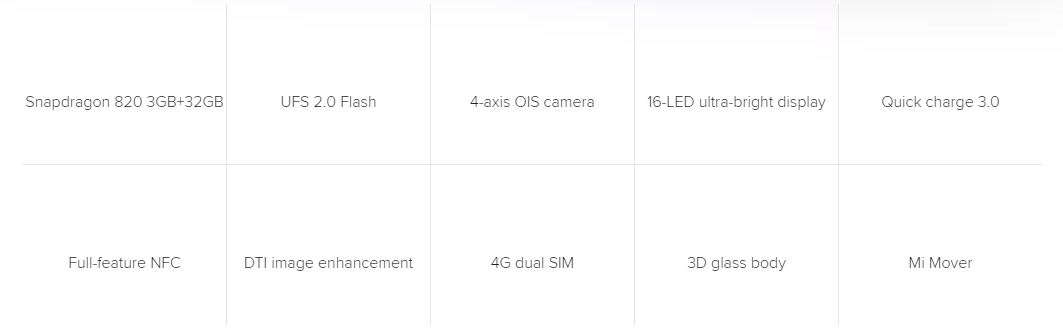

Other features found in the Mi 5 are NFC, Dual nano-sim, Wifi AC standard, Quick Charge 3.0, Voice over LTE (VoLTE). It also supports the latest 4G+/LTE Advanced that has theoretical download speeds of up to 600Mbps (now it all comes down to our telcos to set up the infrastructure).


The device weighs in at only 129grams btw!


The price has been confirmed to be at RM1548 for the base model.


Tuesday, 14 June 2016

HTC 10: The flagship that HTC was supposed to launch years ago


After another quarter of loss profit, I’m starting to wonder if HTC will be here among the tops in the next 2-3 years. They have been producing amazing smartphones starting from the HTC One M7 but seemed to start slacking after it. The only thing that seemed wrong was the Ultrapixel 4MP that promises excellent camera performance especially during low light but was quick to burn out (the famous Purple tint issue, which happened to my model). The successor, One M8, had dual camera which didn’t attracted much attention while maintaining the same design language. The M9 was more like an upgrade of the M8 internally but sadly not in terms of design. There’s nothing wrong with the design, it’s just that a little bit of changes would be nice.


So will the next one be its savior? Please welcome the HTC 10. 


Look wise it has the same basic aluminum unibody design as the previous Ones, but now has a more polished curves at the back of it. Gone is the previous 20MP shooter on the M9 or the dual camera on the M8, instead we are seeing a comeback of the Ultrapixel technology. Learning from their previous mistake, this time the megapixel count gets a bump to 12MP (with OIS and f/1.8) promising excellent camera performance. With several tests done so far it has been delivering. DxOMark has rated it to be on par with the S7/Edge’s camera, that is saying a lot as they now share the top spot for the no 1 camera on a smartphone. 

The camera is situated at the back with laser autofocus and two-tone LED flash right next to it. The launch is said to be quite fast at 0.6 secs, but that remains to be tested.

The camera is also able to record 4K videos with stereo 24-bit Hi-Res audio. Perfect for live performances or concerts (which I personally don’t recommend).


The front camera is also quite impressive. It’s a 5MP camera that has rear-camera features to make it even better such as OIS (one of the first front camera to have this), f/1.8, and wide-lens. Similar to what the iPhone 6S and S7/Edge has, a front screen flash.

You won’t be finding dual Boomsound speakers on this year’s device. Though there’s a Boomsound Hi-Fi Edition speaker at the bottom, but what’s really interesting is the fact that they added an amplifier and Hi-Res Audio processing which ups your audio collection to 24-bit. In essence making them sound better. (I think you’ll need a Hi-res ear/headphones to fully optimize this feature).

Another new aspect this year would be the front home-button which incorporates a fingerprint scanner, which promises to unlock within 0.2 seconds. This is placed between the apps and back touch button.

The display is a 5.2-inch 2K (2560x1440) Super LCD stated to be 30% more colorful.


Moving on to another important aspect would be the performance. It can certainly held its own against other flagship phones as it’s equipped with the latest and greatest Qualcomm Snapdragon 820.

In terms of software, this  HTC Sense 8.0 could be one of the lightest skins on an Android flagship. Running on Android 6.0.1, they have excluded some bloatwares and has more approaches to be similar to Google’s version of Android.


The battery is big as well, a 3,000 mAh that thanks to their PowerBotics system should last you up to 2-days with normal usage. Charging it would not be a problem as the HTC is fitted with the latest USB type-C port which allows Quick Charge 3.0, charging in 30 minutes gives you up to 50% of power.


The device weighs 161grams and is also equipped with Wifi AC, Bluetooth 4.2 and NFC.


Saturday, 27 February 2016

The most radical smartphone concept so far: LG G5


Now let’s focus on the first launched smartphone at MWC 2016 because I think it’s not getting the appropriate attention that it should be, the LG G5.

The event was themed "Let’s Play" to showcase all the latest LG devices.

Staying true to all the leaked images, the new flagship looks impressive. It certainly has a few similarities with the Nexus 6P but that’s not a bad thing. According to Lowyat.net reporter, the G5 feels like a smaller Nexus 6P. The author even added that the G5’s size is actually the one that feels better.

No more rear volume buttons as a compromise to their all-metal unibody design. You could still find the fingerprint reader though. What differentiates it, is that it’s also a button. Just a bit higher than that is not one, but two cameras. LG opted to go dual-camera on its newest smartphone.

One is a 16MP shooter while the second is an 8MP camera that would then allow you to have a wider angle of view of 135 degrees. Probably for panorama or fish-eye shots. Another 8MP camera can be found on the front side of the phone.


Another aspect of the LG G5 that should be given focus on is the bottom part of the smartphone. Apart from allowing the user to change batteries (something lacking in most smartphones). It now can be detached and re-attached with different modules. For example, you can attach a B&O Hi-Fi audio player or even a camera handle called LG Cam Plus. The possibilities are endless and it’s up to LG to decide the limit.

Dwelling deeper onto the 2 modules, apart from giving the G5 a better camera-like grip the LG Cam Plus also has physical buttons for photo, video and even for zoom. It also adds an extra 1200mAh of juice to the G5’s battery. The B&O Hi-fi can also be used as a separate Hi-fi DAC player for PC or other smartphone. 

Continuing on from the last device, the Always-On Display feature that would be showing the date and time even when the phone is asleep. This is achieved with the redesigned display driver IC memory and power management that allows the G5 to only display a portion of the screen, LG stated that this would only draw 0.8% of battery per hour.

Other specifications are Snapdragon 820 as the processor, a 2800mAh battery (with support for Qualcomm QuickCharge 3.0, 4GB of RAM, a 5.3-inch QHD (2560x1440p) IPS display, 32GB of Internal storage and a USB-C port.

No news yet on when the device would arrive. It'll be great to see if this device can shake the market and finally attract the Malaysian market to LG devices.

Source: lowyat, LG


Sunday, 14 February 2016

LG G5 beats the S7 on Geekbench


One of the famous benchmark for smartphones performance is Geekbench. Now there's a new listing that is stirring interest. It looks like a device from LG, more specifically the up and coming LG G5.

LG G5 will come on the same date as the Galaxy S7 that seems to be a bold move from the people at LG. They'll be announcing it a few hours earlier than Samsung.

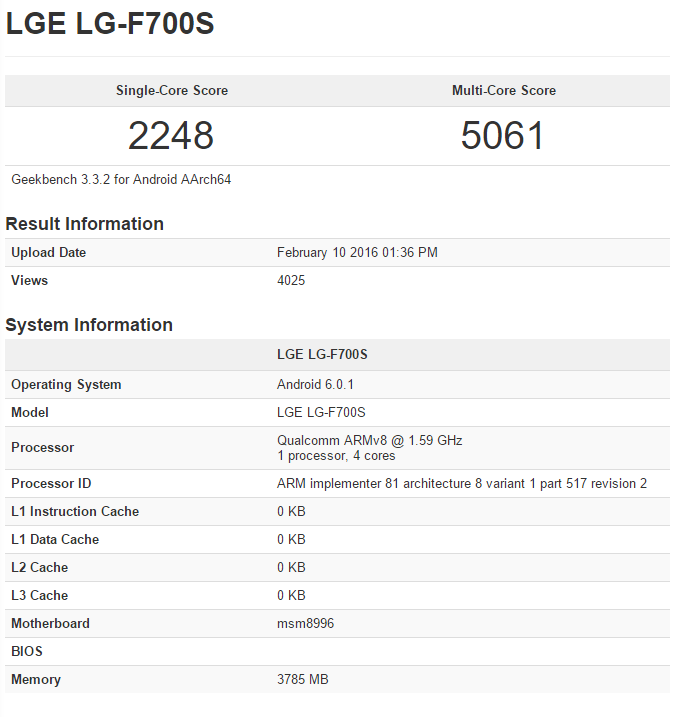
And now they seem to have an upperhand already. The test done on Geekbench shows that the LG G5 appears with a Snapdragon 820, 4GB RAM with Android 6.0.1 managed a single-core score of 2248 and a multi-score of 5061.


This beats the multi-core score by the Samsung Galaxy S7 with Snapdragon 820 that is 4979. Though Galaxy S7 beats the G5 in terms of single-core score with a result of 2282.

One good news for LG but it still hasn't been compared to the S7 with Samsung's own Exynos 8890 that is said to be more powerful.

Take in consideration though, all of these do not guarantee real-life performance.

Source: Techradar, Geekbench, Android Authority

Thursday, 12 November 2015

New Dragon coming, Qualcomm's Snapdragon 820


Following on the “hot” trail of the Snapdragon 810 (see what I did there xP), comes the cooler more powerful successor, the Snapdragon 820.

In terms of built design the thing worth stating is that the new 820 has 4 cores (deemed Kyro CPU) as compared to the 8 cores found on the Snapdragon 810. Their reasoning was that they found out extra cores doesn’t necessarily mean better overall performance (as with the heat issue they had, although other manufacturers such as Samsung and even Mediatek has managed to create not-so-hot 8 cores processor). A perfect case example would be Apple’s iPhone processor which has only 2 cores but has individual performance matching that of their Macbook (real life performance shows it being quite similar to other high end Android smartphones). Now Qualcomm is focusing more on the individual performance of each cores.

Snapdragon 820 is equipped in terms of connectivity with X12 LTE that offers theoretical download speeds of up to 600 Mbps and upload speeds of up to 150Mbps. In terms of Wifi, it now caters to the latest standard which is 802.11ad. To go even better than that there will be support for MIMO of 802.11ad and 802.11ac 2x2 in what they’re calling Advanced Wifi.

In terms of graphics, it’s powered by an Adreno 530 GPU that is said to be consuming 40% less power compared to the previous Adreno 430 while having increased performance. The CPU is also designed to not only handle 4K screens but also provide improvements in terms of lighting, shadows, colour reproduction, and reduced lag.

Technologies that could be found on the processor is Qualcomm Spectra camera Image Signal Processor (ISP) that would allow it to support camera with up to 25 MP. Included as well is the new Snapdragon Low Light Vision (LLV) which should help in producing better low-light photos using adaptive brightness and noise reduction technologies. The most interesting would be the Heterogeneous Signal Processing which produces similar result to HDR without the need to stitch two images together. This is done by analyzing the picture block by block instead.
 
Other than that it is also equipped with the lasts Qualcomm Quick Charge 3.0, 4X faster than conventional charging and 38% more efficient. Smart Protect feature that will prevent threats by detecting them early on.
Overall Qualcomm is promising better and more immersice VR experience on your devices.


Source: Android Headlines, Appy Geek, Qualcomm